
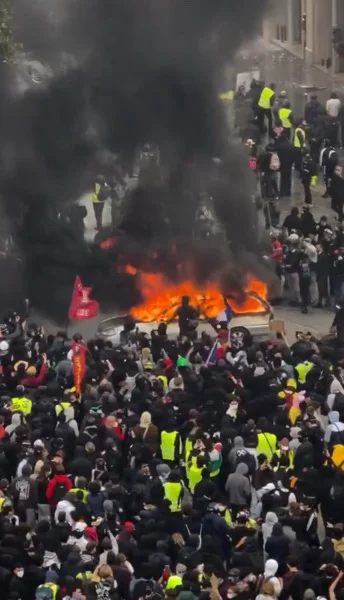
France has a protest problem again. Student demonstrations that started over schools are now, by several accounts, pulling in people angry about what everything costs.
A widely shared account says it began in a Paris suburb in September. Since then trade unions, farmers, taxi drivers and Yellow Vest supporters have reportedly joined the students.
The common thread is money: stretched public services, rising bills, and young people who can't see where they fit.
Key points
- Protests that reportedly began among students have widened into anger over the cost of living.
- Riots on October 17 left a historic town hall torched and led to 1,800 arrests, Gulf News reports.
- Students' reported concerns include overcrowded classes, teacher shortages and the Parcoursup admissions system.
- Many figures in circulating accounts, including turnout and fuel prices, have not been independently confirmed.
- President Macron has rejected foreign leaders' claims that migrants are to blame.
What has been confirmed
A lot of the detail here comes from a circulating account I couldn't fully verify, so I've marked those figures as reported. Major outlets have confirmed the wider unrest. NBC News reports that protests over soaring living costs have led to widespread rioting and looting in France. According to Gulf News, protests on Saturday, October 17 left a historic town hall torched and led to 1,800 arrests, six months before the election to replace President Emmanuel Macron.
The unrest has also become an international political issue. President Donald Trump wrote on Truth Social that "France is burning!" and urged the country to "close your Borders." Macron rejected claims by foreign leaders blaming migrants, calling some of the comments "as unacceptable as they are stupid," NBC News reports. He also said AI-generated images had shown "scenes that never actually happened in France."
Why are students on the streets?
School is where it started.
The account claims that more than 1,000 high schools were affected during the early stages of the movement, with hundreds allegedly closing on a single day.
Their complaints, as reported: classes are packed, there aren't enough substitute teachers, it's hard to see a school nurse or counselor, and some buildings are falling apart.
Then there's Parcoursup, the national platform students use to apply to university.
Critics say it leaves teenagers waiting for months without knowing where they'll study, and that nobody can explain how places are handed out.
For a lot of them, it's less about leaky roofs than about whether school still leads anywhere secure.
What the government has offered
The circulating account says the Education Ministry responded by opening a dialogue initiative and promising additional substitute teachers.
Some protesters reportedly called that a sticking plaster, since temporary staff don't fix the shortage underneath.
The account also gives numbers for arrests and injuries among protesters and police.
I haven't seen those confirmed by the government or by major outlets yet, so I'm not repeating them.
How it turned into a cost-of-living protest
Once household bills came into it, the movement reportedly spread well beyond schools.
That isn't unique to France. Fuel and energy have squeezed households all over Europe.
The circulating account claims that fuel prices exceeded €1.80 per liter and that household gas prices increased in October.
Some demonstrators have reportedly tied the two together: underfunded schools and a pay packet that doesn't stretch.
The Yellow Vest link isn't a small detail. That movement began in 2018 over a fuel tax and grew into months of weekend protests about living costs and who pays for what.
Borrowing their slogans looks deliberate.
Who is marching
According to the account, demonstrations on October 17 brought together several groups with different concerns.
Students wanted better schools. Yellow Vest supporters talked about purchasing power. Unions, farmers and taxi drivers were described as being there too, each with their own list.
The account gives competing estimates of the nationwide turnout, with the Interior Ministry figure reportedly lower than the number cited by trade unions.
That gap is normal in France. The ministry and the unions count differently, and both have a reason to.
One slogan reportedly seen on the marches was "Youth and Yellow Vests, One Struggle".
The debt in the background
Then there's the state's own money.
France owes a lot, and borrowing costs more than it used to, which leaves the government little room to spend its way out of this.
The account claims French borrowing costs hit unusually high levels and that Moody's put the country on negative review. I couldn't confirm either from Moody's own announcements, so treat both as unverified.
The 2027 budget fight could make things worse if the savings land on families who are already struggling.
How much worse depends on what's actually in it, and nobody has seen the final text.
Clashes and damage
The account describes violence and damage in Paris, Marseille, Lyon and Limoges.
It says police used tear gas and water cannon, and that investigations into possible police misconduct were opened.
Neither police nor prosecutors have confirmed those details publicly that I could find.
A riot in one street doesn't make every marcher a rioter. And a peaceful march somewhere else doesn't mean nothing serious happened.
In France, how the police handle a protest often becomes its own story.
Were most of the marches peaceful?
The account says yes, overwhelmingly, and describes marches full of signs about students' futures and failing public services.
Its figure of 90% peaceful is one I can't check.
On a big protest day you can get a calm march in one city and burning bins in another, sometimes a few hours apart.
That's worth remembering when a single video gets passed around as proof of what "the protesters" are like.
What happens next
A lot rides on whether the unions stay in after the students go back to class.
The account says some students are planning more action after the autumn school holiday. The government will probably try talks first.
Nobody knows yet if that works.
With the presidential election about six months away, every week of this lands on the campaign.

Why it matters
In France, street protests have changed government plans before. When students and workers march together, it stops being about one policy and becomes an argument about who the country is run for.
And the grievances here aren't French only. Squeezed services and higher bills are a problem in plenty of European countries.
What's different in France is how fast people take it to the street.
If the reports hold up
If the reports are confirmed, this is bigger than a row about schools.
It's people saying their wages, their kids' schools and their prospects are all slipping at once.
Students want a fair shot. Families want pay that covers the basics. The government wants to answer both without blowing the budget, and I'm not sure it can.
Watch the first weekend after the school holiday. If turnout holds then, this has legs.


Comments